This week I spent time unpacking the three core pieces of ESTGEL in a way that actually makes sense outside of academic papers.
To make the model easier to understand, I like to think about a growing school full of students. The students are the nodes, and their friendships are the edges. In our embryo world, the students become cells and the friendships become physical or lineage connections.
The Three Modules, Explained Like a School Network
1. EAM: The Friendship Rater
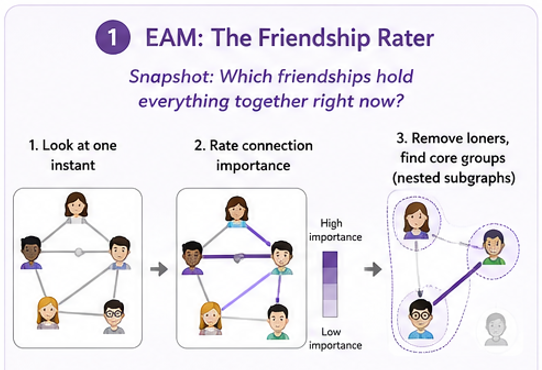
If you snapshot the school at one instant, EAM is the part of the model that asks, “Which friendships are holding everything together right now?”
- Concept: EAM looks at one moment in time and finds the structural connections that matter most.
- How it works: It computes an importance score for each connection based on how many relationships each student has.
- What it does: It temporarily removes the loners the students with the fewest relevant friendships and discovers the core friend groups. These are the “nested subgraphs” the paper talks about.
Imagine Alice and Bob are the only two students who bridge the drama club and the soccer team. EAM will highlight their friendship as extremely important because it structurally connects two otherwise separate groups.
In the embryo, EAM takes a 3D cluster of cells at one specific minute and assigns high attention scores to the physical cell-to-cell contacts that are critical to the embryo’s shape in that moment.
2. DRL: The Relationship Tracker
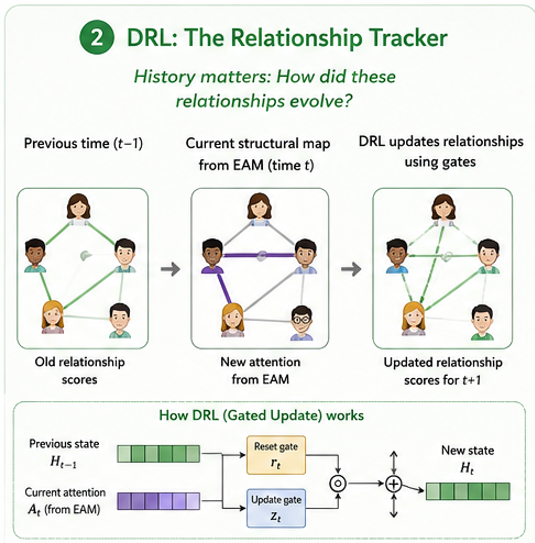
Friendships change over time. DRL is the module that tracks those changes.
- Concept: DRL knows that a connection at time
tdepends on what happened at timet-1. - How it works: It uses reset and update gates to decide what historical relationship information to keep, what to forget, and how to mix it with today’s new interactions.
- What it does: It turns old friendship history and current structural attention into a refreshed relationship score.
Think of Charlie and Dave: they used to be best friends, but today they barely spoke. DRL acts like a memory tracker and decides whether they are drifting apart or just having a quiet day. The result is an updated friendship score for tomorrow.
In the embryo, DRL takes the structural map from the previous minute and updates it with the new EAM map, so the model understands how cell relationships evolve as the embryo grows.
3. DNL: The Personal Growth Updater
Now that the model knows who is connected to whom, DNL asks: how does that affect each individual?
- Concept: DNL updates the internal state of the nodes based on their changing environment.
- How it works: It uses a Graph Convolutional Network (GCN) so each student absorbs information from the friends DRL says are most important right now.
- What it does: It blends the new absorbed information with the student’s past state using temporal gates.
Imagine Eve starts hanging out with the math club. Because she is now connected to those friends, she absorbs their habits and her math profile improves. DNL updates Eve’s internal profile to reflect this new state.
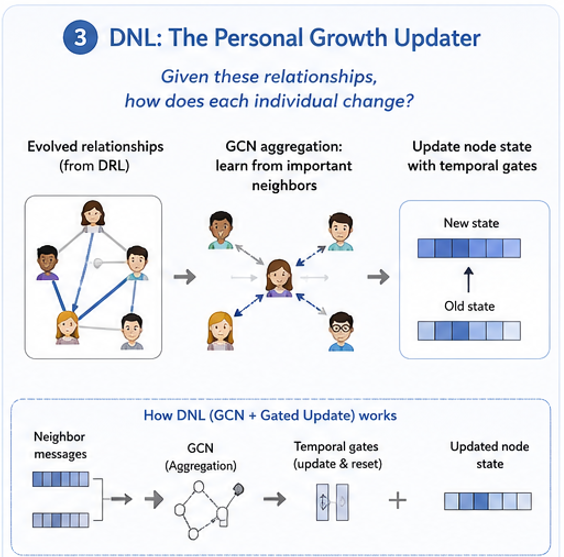
In the embryo, a cell’s biological state gene expression, signaling activity, or other features changes based on the neighbors it touches. DNL updates the cell’s mathematical profile to reflect those biological changes.
How the Flow Works Together
- EAM takes a picture of cells right now and says, “These physical contacts are the most important.”
- DRL looks at that picture and says, “Based on where these cells were a moment ago, here’s how their relationships evolved.”
- DNL takes those evolved relationships and says, “Because this cell is now touching these neighbors, its internal state has changed.”
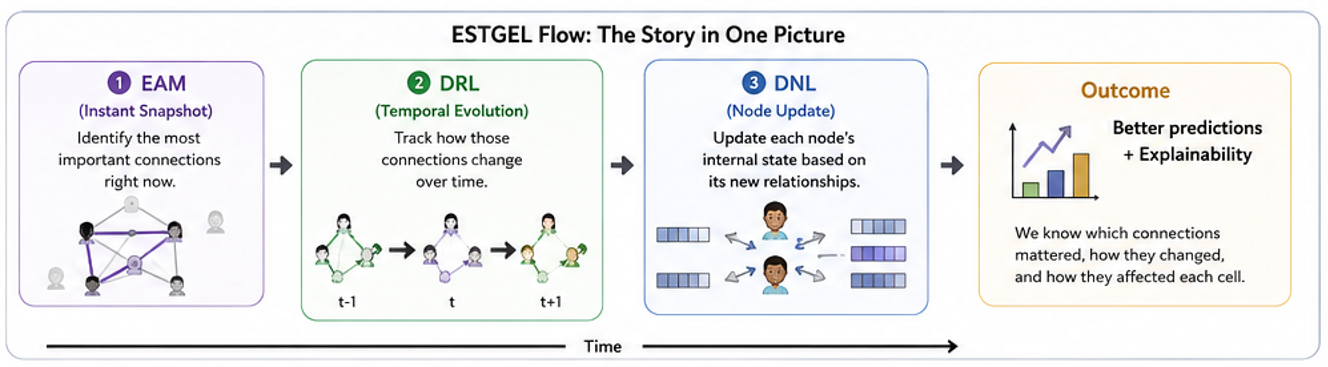
This is the clean version of ESTGEL’s story: first identify the important edges, then learn how those edges change through time, and finally update the nodes themselves based on their new relationships.
Why This Matters
For biological systems, especially something like an embryo, this is powerful because it matches how real development works:
- structures appear and disappear,
- relationships shift over time,
- and the cells themselves are changed by the people they interact with.
Putting it another way: EAM judges the social scaffolding at each instant, DRL tracks the history of the friendships, and DNL updates the individuals based on their social life.
That’s the story I want to tell this week: ESTGEL is not just another graph model. It’s a model that thinks like a growing school, where connections matter, relationships move, and individual cells keep changing because of the community around them.